
The Technology
A new paradigm in armoured cable and coiled tubing construction
Conventional armoured cables are built by helically winding multiple layers of steel wires or strips around an inner core. This produces a cable that is flexible enough to install but suffers from inherent torsional imbalance: the layers create competing internal stresses that, under compression or repeated handling, cause the wires to "bird-nest" — splaying outward and damaging both the armour and the inner core. Multi-layer designs also leave gaps that admit moisture and chemicals, and present uneven outer surfaces that increase friction during installation.
Conventional coiled tubing has its own failure modes: kinking and ovalisation under bending, fatigue at the edges, and limited resistance to high pressure and aggressive chemicals.
ARCAB's patented technology solves these problems together by replacing the multi-layer construction with a single-layer armouring built from interlocking high-strength steel profiles.
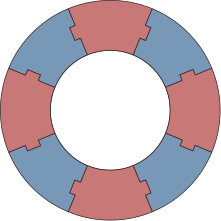
Six properties that conventional designs cannot achieve simultaneously
Torsionally balanced
Unlike multi-layer designs, the interlocking single-layer armour eliminates the internal stresses that lead to bird-nesting and premature failure under compression. The cable retains its mechanical integrity through repeated installation, retrieval, and operational cycles.
Structurally stable when bent
Within its operational bend radius, the cable retains a perfectly circular cross-section. This protects the inner electrical or optical conductors from the deformation damage that conventional armouring inflicts when the cable curves, and ensures consistent fluid flow when the technology is used as standalone coiled tubing.
Semi-rigid and pushable
The armour gives the cable significant columnar strength — the ability to be physically pushed into horizontal or complex pathways without buckling. This dramatically reduces the need for tractors, intervention tools, or other expensive deployment equipment in long horizontal wells, conduits, or trenches.
Smooth and low-friction outer surface
The continuous, uninterrupted outer surface of the single-layer armour reduces friction during installation and retrieval. This enables faster deployment speeds, longer reachable runs, and — crucially for environmentally regulated installations — eliminates the need for greasing operations in pressure control heads.
Gas-tight, impermeable, and robust
The solid steel sheath is genuinely impermeable to gases and liquids. It withstands pressures up to 450 bar, temperatures up to 280 °C in operational service, and chemical attack from hydrogen sulphide (H₂S), ammonia, and sulphuric acid. The material itself withstands the much wider range of −50 °C to +350 °C.
Versatile core
The same armouring technology serves multiple roles depending on what is wound inside it: electrical cable conduit, fibre-optic cable conduit, or standalone coiled tubing for fluid and gas transport in oil and gas, geothermal, and chemical-process applications.
Controlled flexibility — the core innovation
The fundamental design principle that enables all six properties is what we call controlled flexibility: the engineered balance between rigidity and bendability.
Conventional products are either fully rigid (like a solid pipe — strong but cannot be coiled, transported on a drum, or installed around bends) or fully flexible (like a standard electrical cable — coilable but cannot be pushed, deforms under load, and lacks structural integrity). ARCAB's interlocking armour is engineered to be flexible for installation and rigid for performance, simultaneously.
The animation shows the priciple of ARCAB's interlocking strands gliding longitudinally as the cable bends (not to scale) — outer-arc strands stretching, inner-arc strands compressing. The interlock keeps the wall together radially; the slip lets it bend without kinking or breaking.
Patent portfolio
The technology is protected by four granted patents from a single inventor partnership: Werner Führer and Werner Haberkamp, with priority date 10 October 2014.
EP 3 007 178 — High Rigidity Cable (European, granted)
EP 3 007 179 — High Rigidity Cable and Method for Producing the Same (European, granted)
EP 3 006 801 — "Coiled-Tubing"-Type Flexible Pipe and Production Method (European, granted)
DE 10 2014 014 793 B4 — Kabel hoher Steifigkeit und dessen Verwendung / High-Stiffness Cable and Its Use (German national, granted January 2026)